Two people stand before a judge on similar charges. Before sentencing, each has answered a long questionnaire: prior convictions, but also when they first had contact with the police, whether friends or family have records, what kind of neighbourhood they grew up in. A statistical model turns the answers into a recidivism risk score, and that score can weigh on how long each of them spends in prison. Across town, a family applies for a mortgage online; within a minute, a scoring system has weighed data they will never see and declined them, with no loan officer to argue with. Cathy O’Neil calls systems like these “weapons of math destruction” (O’Neil 2016): opaque, operating at massive scale, and damaging to the people they score. Decisions that once rested on human judgment are now calculated.
Llull’s Wheels
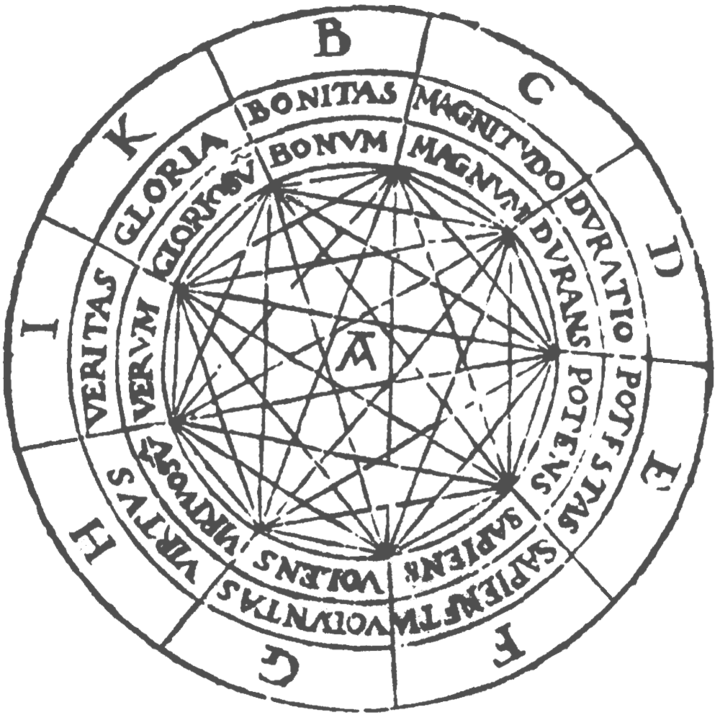
Thirteenth century theologian Raymond Llull wrote forty treatises on a novel approach to discovering universal truths, collected in his Ars magna (Llull 1501; see also Gardner 1958). The work serves as a user’s manual for a device containing concentric rotating wheels inscribed with letters meant to represent what he believed were the fundamental axioms of truth: God, justice, goodness, eternity, and so on. By turning the wheels, one could explore combinations of these principles and arrive at new metaphysical insights. Llull’s Ars magna stands as one of the earliest documented attempts to apply formal and mechanical reasoning to problems that had previously belonged to philosophy, theology, and human judgment.
Let Us Calculate
Gottfried Wilhelm Leibniz, co-inventor of the calculus and early champion of symbolic logic, encountered Llull’s ideas as a teenager and renamed the method ars combinatoria (Leibniz 1666). He expanded Llull’s rotating diagrams into his own interlocking gear mechanisms, which eventually inspired the first mechanical calculator capable of addition, subtraction, multiplication, and division: the stepped reckoner. Leibniz imagined a far more ambitious future. He dreamed of a characteristica universalis (Leibniz 1981), a symbolic language that, together with a calculus ratiocinator for reasoning in it, could resolve intellectual disputes through calculation alone. In a later manuscript he wrote (translated in Russell 1900, 170):
If controversies were to arise, there would be no more need of disputation between two philosophers than between two accountants. For it would suffice to take their pencils in their hands, to sit at their slates, and say to each other (with a friend to witness, if they liked): Let us calculate.
Leibniz’s Dream at Scale
Leibniz believed abstraction and formal symbol manipulation could remove subjective interpretation and lead to universally agreed truths. This vision foreshadows modern computing’s tendency to offload decision making onto mechanical procedures and automated systems. Today we routinely compute outcomes for people at massive scale in the form of mortgage approvals, bail recommendations, algorithmic rankings, and content curation. In a sense Leibniz’s dream has begun to come true, although it invites a difficult question: what do we trade away when we let calculation decide?